The Golden Circle in winter
Between November and February the sun stays low all day and Gullfoss freezes at the edges, yet the tours keep running unless a storm closes the roads. A winter day on the loop is shorter and colder than a summer one, and often lovelier for it. Plan for ice underfoot and a spare day in case the weather wins.
What changes from November to February
The loop follows the same road to the same classic stops, but almost everything around it shifts. Daylight shrinks from about seven hours in November to four in December, then climbs back to about eight by February. Daytime highs stay close to freezing, and the wind across the open plateau makes them feel far colder.
| Month | Daylight in Reykjavik | Usual daytime high | On the loop |
|---|---|---|---|
| November | About 7 h | 39 °F (4 °C) | The last stop often at dusk |
| December | About 4 h | 36 °F (2 °C) | Leave and return in the dark |
| January | About 5 h | 37 °F (3 °C) | Icy paths, low sun all day |
| February | About 8 h | 37 °F (3 °C) | Longer light, storms still possible |
A Golden Circle tour lasts 7–8.5 hours on the big bus and about 8 hours on Nicetravel's small group at ~$119, so in midwinter part of every tour falls in darkness. In December a morning departure leaves before sunrise and comes home after sunset, and the last stop of the day, often Kerið or Þingvellir, may come at dusk. The best-time guide sets winter against the rest of the year.
Light that stays golden all day
The low sun is what winter gives back. It never climbs far above the horizon, so the light stays warm and the shadows stay long for the few hours it is up, the kind of color a summer visitor only sees late in the evening. Steam from the Geysir field glows in it, and the spray over Gullfoss catches it from the side.
Morning departures make the most of those hours. An afternoon tour that suits a summer day can lose several of its stops to the dark in winter. BusTravel's afternoon tour at ~$80 is the cheapest seat on the loop, and its catch in midwinter is the late start, which means some sights are seen in darkness. Only its 10:30 departure stops at Kerið, so read the time on the listing before you book. BusTravel's classic departures at noon or later also skip Kerið, so choose an early one if you want all four stops in daylight.
The stops under snow and ice
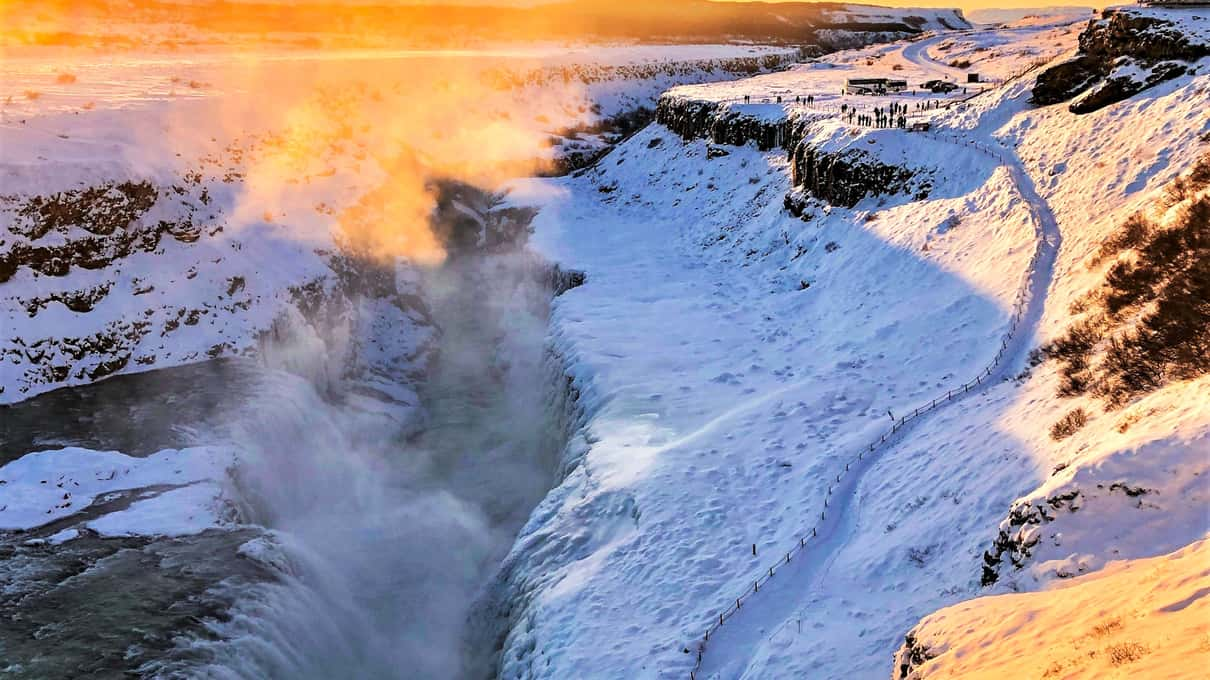
Gullfoss changes the most. In a hard frost the falls freeze in part, with ice formations building along the two drops while the river keeps pouring through the middle. The lower path toward the edge may be closed for ice, which leaves the upper viewpoint by the café.
At Geysir the cold works in your favor. Strokkur's steam is much bigger in freezing air, and the whole field smokes around it. The pools are as hot as ever, so stay behind the ropes even when snow hides where the path ends. Kerið's lake freezes and lies under snow inside its red walls, and Þingvellir under fresh snow looks like a different park from the green one in the summer photos. The stops, one by one has what to see at each.
Ice on the paths
The paths at Geysir and Gullfoss ice over in winter, and the walk down into the Almannagjá gorge at Þingvellir can be slick as well. Shoes with a deep tread are the minimum, and microspikes or ice cleats stretched over them make the difference between shuffling and walking. Take small steps on any slope and keep your hands free for balance.
Dress for standing still, which is most of what you do at the stops. Under a windproof shell with a hood you want a thermal base and a wool or fleece layer, and a warm hat and gloves matter more than a second sweater. Our clothing guide goes through each layer.
When a storm cancels the tour
The tours run daily through the winter, but a storm can still cancel one or shorten another when roads close. All six main tours let you cancel without charge up to a day ahead, and a storm that stops the operator gets you another date or your money back. Book the Golden Circle early in your trip, so a lost day can be made up later in the week.
Watch the forecast for wind as much as for snow. The Icelandic Met Office at vedur.is carries the weather warnings, and the road map at road.is shows which roads are open. SafeTravel posts alerts for visitors too. Look at them the evening before and again in the morning.
Picked up at your door on a dark morning
Reviews of the big coaches often mention long waits in the cold for the pickup shuttle. Nicetravel's small group collects you at your hotel in a minibus of 19 at most, with Kerið's entry included, for ages 5 and up. Free cancellation until 24 hours before lets you watch the forecast first.
Driving the loop yourself in winter
Every road on the classic loop is paved, but winter adds ice and blowing snow to long hours of darkness. Studded tires help a great deal. Hold the car door with both hands whenever you step out, since a winter gust can bend it back on its hinges and many rental policies leave that damage to you.
Storms close roads in Iceland, and the road map at road.is is the place to see which ones. If you are not used to driving on ice in the dark, a tour is the safer choice in these months, and our self-drive guide weighs the rest of that decision.
Hot water in the snow
A lagoon may be at its finest when it snows. Sitting in the Secret Lagoon's water, around 100–104 °F (38–40 °C), while flakes land on your hair is one of the pleasures of a winter trip. BusTravel's Secret Lagoon day at ~$129 puts Kerið first, and some winter reviewers say they reached the crater before daylight, so you may see it in half-light.
The Sky Lagoon finishes the day after dark for most of the winter, with the infinity edge looking out over a black sea. Nicetravel's Sky Lagoon day at ~$235 runs in all weather and arrives at the lagoon just before 5 pm. Bring a hat for wet hair on the walk back to the minibus. Our lagoon guide compares them in any season.
Northern lights, and a day on the glacier
From about September to April the northern lights can appear, but only against a dark, cloudless sky, so a daylight tour never includes them and no operator can guarantee a sighting on a given night. BusTravel's Golden Circle and northern lights at ~$151 joins the two in one coach trip, sold on Viator only, with a break of about two hours in Reykjavik before the evening hunt. The catch is a 12.5-hour day, and the lights are never promised. Many visitors do better with the day tour on its own and a separate evening out on a night the forecast looks clear.
For snow on purpose, the Langjökull snowmobiling day at ~$361 takes you from the loop up onto the glacier. Its catch is the price, the highest of any day we compared, and it is sold on Viator only, where it scores 4.7 out of 5 from 1,574 reviews.